Views: 0 Author: Site Editor Publish Time: 2026-06-17 Origin: Site

Transitioning from the procurement of a liquid nitrogen freezer to active operation is a streamlined and highly rewarding process when guided by expert engineering. Proper installation of cryogenic quick freezing equipment ensures peak thermal efficiency, optimized nitrogen consumption, and exceptional product yields. At Shaoxing Jiesheng Food Machine Technology Co., Ltd. (Wuye Machinery), supported by over 30 years of experience in food machinery design and production, we emphasize a rigorous, phased approach to site preparation, safety infrastructure integration, and precise mechanical commissioning. This guide details the technical roadmap for installing industrial quick freezing equipment to ensure regulatory compliance and immediate operational ROI. We will walk through the exact site requirements, rigging procedures, piping connections, and safety standards necessary to get your production line running smoothly. Proper execution ensures your facility handles ultra-low temperatures with maximum efficiency and reliability.
Site Readiness Ensures Optimal Performance: Structural integrity, specialized ventilation, and vacuum-jacketed piping routes establish the foundation for highly efficient equipment operation.
Safety Infrastructure Secures the Environment: Fixed oxygen sensors, personal O2 monitors, localized exhaust systems, and operator PPE protocols are standard prerequisites for advanced cryogenic systems.
Phased Commissioning Validates Throughput: Proper installation concludes with rigorous load testing and thermal calibration to guarantee the system meets its specified production capacity (e.g., 200 to 2000 kg/h).
Vendor Expertise Maximizes Value: Partnering with the professional R&D team at Shaoxing Jiesheng Food Machine Technology Co., Ltd. (Wuye Machinery) for final tank connections and vacuum-piping integration ensures long-term equipment reliability and consistent freezing quality.
The facility must be physically and environmentally prepared to harness the ultra-low temperatures of -196°C and the rapid expansion ratio of liquid nitrogen to gas, which sits at 1:694. Preparing the site correctly guarantees the quick freezing equipment operates at peak thermal efficiency. A well-planned utility and structural layout provides the perfect environment for seamless freezing food operations.
Evaluating the physical space is the first step in the installation process. The flooring is designed to support static loads and accommodate advanced mechanical setups. Concrete slabs with specialized epoxy coatings rated for cryogenic exposure provide an excellent foundation.
Evaluate floor load-bearing capacity to support heavy stainless-steel enclosures, internal conveyor assemblies, and dense product loads.
Map out clearance zones for maintenance access, conveyor belt tensioning, and operator movement. Leave at least one meter of clearance on all sides of the tunnel for optimal workflow.
Determine the optimal location for the external bulk liquid nitrogen storage tank relative to the internal freezing unit to minimize piping distance and maximize thermal conservation.
Select the phase storage delivery method based on the specific requirements of your setup. Liquid-phase delivery utilizes specific valving configurations for optimal flow.
Assess ceiling height for exhaust duct routing and overhead crane access during the initial rigging phase.
Dedicated ventilation is a standard requirement to maintain a highly controlled environment for operators working near the production line. Purpose-built exhaust systems are expertly designed to manage the volume of nitrogen gas generated during continuous freezing operations.
Calculate required air exchange rates to efficiently manage the continuous flow of nitrogen gas in enclosed production spaces.
Design and route dedicated exhaust ducting from the freezer's extraction port directly to the building exterior. Utilize 304 stainless steel ducting for premium durability.
Ensure exhaust systems are equipped with variable frequency drives (VFDs) to automatically optimize extraction rates based on live freezing volumes.
Install makeup air units to balance the pressure dynamically, creating a perfect operating atmosphere.
Modern cryogenic systems rely on precise electrical controls and utility inputs to manage the flow of liquid nitrogen and the movement of the product. A consistent power supply ensures uninterrupted PLC functions and uniform freezing quality.
Audit electrical panels for sufficient amperage to power conveyor motors, high-velocity internal circulation fans, exhaust fans, and programmable logic controllers.
Verify the availability of clean, dry compressed air for pneumatic control valves. Air dried to a dew point of -40°C ensures flawless valve actuation.
Establish network connectivity for remote telemetry, automated diagnostic logging, and intelligent gas consumption tracking.
Install dedicated grounding rods to dissipate static electricity generated by the high-speed stainless steel conveyor belts.
Utility Category | Requirement Checklist | Performance Standard |
|---|---|---|
Electrical Supply | Dedicated breakers, PLC power isolation, VFD compatibility | Stable voltage during motor startup |
Ventilation | Direct exterior exhaust, VFD-controlled extraction fans | Maintain ambient O2 above 19.5% |
Pneumatics | Clean, dry compressed air lines | Dew point -40°C for seamless operation |
Network | Cat6 Ethernet, static IP assignment | Uninterrupted telemetry data flow |
Operating advanced cryogenic equipment involves managing ultra-low temperatures efficiently. Proactive safety engineering ensures a secure operating environment for all personnel. Shaoxing Jiesheng Food Machine Technology Co., Ltd. (Wuye Machinery) designs systems that build a robust safety network, operating seamlessly alongside your production processes.
Continuous atmospheric monitoring is standard practice for maintaining a safe workspace. Sensor placement and alarm integration follow strict industrial guidelines, providing comprehensive coverage across the entire production floor.
Install fixed oxygen monitors at typical breathing height (approximately 1.5 meters) in all areas where liquid nitrogen is utilized.
Equip operators with personal oxygen monitors for enhanced localized monitoring.
Integrate highly visible strobes and audible signals designed to communicate operational status clearly.
Connect sensor relays to automated shut-off valves on the main liquid nitrogen supply line for intelligent source management.
Calibrate all sensors using certified test gases prior to the initial system startup.
Appropriate physical protection ensures staff can confidently interact with the equipment during operation or maintenance. Specialized PPE is highly effective for working with -196°C temperatures.
Mandate site-specific PPE, including heavy-duty cryogenic gloves, full face shields, safety goggles, and professional safety footwear.
Develop, print, and display clear Standard Operating Procedures (SOPs) based on Shaoxing Jiesheng Food Machine Technology Co., Ltd. (Wuye Machinery)'s expert guidelines for system startup, shutdown, and line-purging.
Conduct professional operational training with all shift supervisors and maintenance personnel.
Establish a dedicated PPE storage station immediately adjacent to the freezing line to ensure easy access.
Adhering to local and international standards ensures long-term operational compliance and highlights your facility's commitment to industrial excellence.
Review installation plans against local industry codes and ASME standards, specifically ASME B31.3 for pressure piping.
Secure necessary environmental and municipal permits for industrial storage and exhaust modifications.
Schedule a pre-commissioning walkthrough with safety officers to verify all modern safety interlocks are perfectly configured.
Execution requires seamless coordination between industrial riggers, mechanical pipefitters, commercial electricians, and certified specialists. Following our structured phase approach, backed by 12 National Patents in machinery design, ensures the exceptional mechanical integrity of the freezing tunnel.
Moving sophisticated cryogenic equipment requires professional handling to protect the highly engineered internal components and advanced insulation panels, ensuring the thermal envelope remains pristine.
Coordinate heavy machinery capable of safely maneuvering the modular freezer sections into the facility. Use specialized skates for precise positioning.
Inspect all components upon arrival to verify the pristine condition of internal conveyor belts, nozzle manifolds, and polyurethane insulation panels.
Level the equipment precisely using adjustable leveling feet to ensure uniform liquid nitrogen distribution and superior drainage during cleaning cycles.
Verify that all modular sections align perfectly to maintain the high standards set by Shaoxing Jiesheng Food Machine Technology Co., Ltd. (Wuye Machinery).
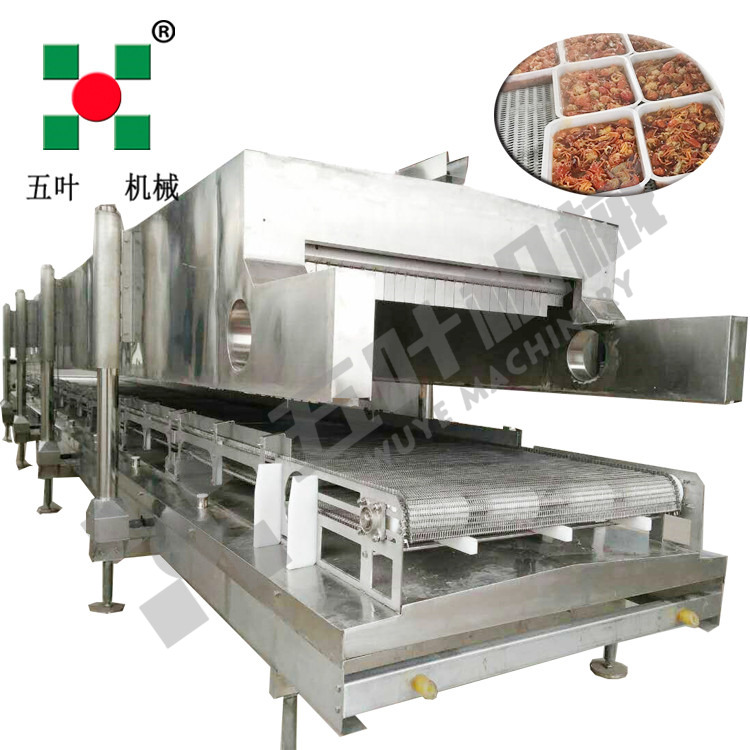
Proper mechanical assembly of the liquid nitrogen tunnel quick freezer ensures structural integrity and maximizes thermal retention during operation. The tunnel is designed to seal tightly, providing an optimal freezing environment.
Align and securely bolt modular tunnel sections together using premium cryogenic-grade gasketing.
Install, tension, and track the stainless-steel mesh conveyor belt for exceptionally smooth running performance.
Mount internal circulation fans, baffles, and spray manifolds according to our precise engineering schematics.
Connect the internal drive motors and verify the gearbox alignment to ensure long-lasting drive shaft durability.
The piping network is engineered for superior efficiency. Proper insulation and precise valve placement guarantee that liquid nitrogen remains in its most effective liquid state until it exits the spray nozzles.
Install vacuum-jacketed (VJ) piping from the external storage tank to the freezer inlet to maximize thermal retention and prevent exterior condensation.
Fit high-grade cryogenic solenoid valves, pressure relief valves (PRVs), and phase separators to expertly manage nitrogen vapor.
Execute final critical connections under the direct supervision of qualified engineers to guarantee secure, leak-free couplings.
Weld all non-VJ pipe sections using orbital welding techniques to ensure flawless internal surfaces for optimized liquid flow.
The intelligent control panel coordinates belt speed, exhaust rates, and nitrogen injection based on real-time sensor data, ensuring your food production lines run with absolute precision.
Wire the main control panel directly to the facility's power supply using industrial-grade cabling.
Connect all advanced internal sensors, including RTDs, thermocouples, and pressure transducers, to the central control unit.
Perform point-to-point wiring checks to verify signal integrity before energizing the system.
Program the PLC with the optimized baseline parameters provided by the Shaoxing Jiesheng Food Machine Technology Co., Ltd. (Wuye Machinery) technical team.
This phase transitions the equipment into a highly active production asset. We systematically validate performance under load to ensure the machine easily achieves its target operating temperatures and delivers exceptional product quality from day one.
Conditioning the piping network before introducing liquid nitrogen is standard procedure to ensure moisture-free lines, guaranteeing smooth and continuous mechanical operation.
Purge the cryogenic piping system with dry gaseous nitrogen to create an optimal, moisture-free internal environment.
Gradually introduce liquid nitrogen to chill the piping and the internal chamber, utilizing a controlled cool-down phase for perfect material adaptation.
Conduct comprehensive system checks on all joints, valves, and fittings using specialized cryogenic-approved verification methods.
Monitor the pressure relief valves during the initial fill to confirm precise set-point operation.
Different food products benefit from distinct thermal profiles. Adjusting the system parameters ensures optimal freezing that perfectly preserves the cellular structure and taste of the product.
Adjust spray nozzle pressure, fan speeds, and dwell times to match the exact thermal profile of the target product.
Calibrate belt speed and nitrogen dosing for a tropical fruit liquid nitrogen IQF freezer to ensure rapid, individual crust freezing, locking in moisture and delivering premium quality.
Set up intelligent recipe profiles in the HMI for rapid, seamless changeovers between different food production runs.
Validating the mechanical throughput confirms the system smoothly handles the robust production demands expected from a high-tier facility.
Run initial batches to map brilliant internal temperature consistency across the entire width of the belt.
Transition to live product testing to validate the specified capacity, confirming an LND 200-2000kg/h liquid nitrogen tunnel freezer consistently processes the target volume with ease.
Fine-tune the advanced PLC control loops to optimize nitrogen consumption ratios for maximum cost-efficiency.
Measure the core temperature of the exiting product to verify it consistently meets the strict -18°C premium storage standard.
Long-term operational success is supported by maintaining thermal efficiency and proactive maintenance. A well-maintained cryogenic system designed by Shaoxing Jiesheng Food Machine Technology Co., Ltd. (Wuye Machinery) will deliver decades of reliable, high-yield performance for your refrigeration system needs.
Establishing a routine inspection cadence keeps the machinery in pristine condition. Operators are empowered to take ownership of daily performance checks.
Establish daily visual checks for exhaust vents, safety relief valves, and vacuum-jacketed piping joints to confirm perfect operation.
Schedule monthly calibrations for fixed and personal oxygen sensors to ensure top-tier system responsiveness.
Implement a proactive maintenance plan for conveyor parts, drive chains, and cryogenic circulation fans to ensure continuous smooth running.
Inspect the exhaust ducting quarterly to verify optimal structural integrity.
As your market share grows, our freezing infrastructure is designed to scale with you elegantly, utilizing the 1500 m² plant area capabilities of our manufacturing base to support your expansion.
Leverage the modular flexibility of the installed system to easily handle future volume increases via straightforward tunnel extensions.
Evaluate the streamlined process of upgrading external bulk nitrogen storage infrastructure as your production demands flourish.
Ensure electrical panels are provisioned with spare capacities to effortlessly accommodate additional exhaust fans or extended conveyor drives.
A rigorous, step-by-step installation process is the foundation of a highly efficient and successful cryogenic freezing operation. Built on the trust of more than 1000 domestic and foreign food processing enterprises, Shaoxing Jiesheng Food Machine Technology Co., Ltd. (Wuye Machinery) recommends executing the following steps for immediate operational excellence:
Finalize all structural and ventilation preparations to create an ideal operating environment prior to delivery.
Install and calibrate all modern oxygen sensors and intelligent exhaust systems for comprehensive operational security.
Engage specialized engineers to oversee the final vacuum-jacketed piping connections and initial system optimization.
Conduct thorough load testing to map outstanding thermal consistency before running live commercial batches.
Provide team members with expert training on system operations and proper PPE usage.
A: Industry standards mandate that ambient oxygen levels must remain above 19.5%. Advanced automated systems ensure the environment stays safely within these optimal parameters.
A: Vacuum-jacketed piping provides superior thermal insulation, maximizing efficiency by ensuring the liquid reaches the freezer nozzles in its most effective state, while maintaining a clean exterior.
A: The initial cool-down phase typically takes 30 to 60 minutes. Liquid nitrogen is introduced gradually to condition the high-quality stainless steel components perfectly for ultra-low temperature operation.
A: Cryogenic freezers perform best with dedicated, direct-to-exterior exhaust ducting equipped with variable frequency drive fans. This purpose-built approach expertly manages the continuous flow of nitrogen gas.
A: Operators utilize heavy-duty cryogenic gloves, a full face shield, safety goggles, and professional safety footwear. This specific gear ensures personnel remain completely comfortable and protected when interacting with supercooled surfaces.
A: Fixed and personal oxygen sensors should be calibrated at least once a month using certified test gases. Regular calibration ensures the sophisticated safety network remains highly accurate and responsive.