Views: 0 Author: Site Editor Publish Time: 2026-09-14 Origin: Site

The industrial frozen vegetable market demands strict preservation of cellular structure, texture, and nutritional value. Transitioning from basic freezing methods to advanced rapid-freezing technologies is a strict operational mandate for processing facilities. Many operators confuse industrial quick freezing with freeze-drying. We focus strictly on high-throughput freezing systems designed to rapidly lower core temperatures and lock in moisture for commercial distribution.
Selecting the wrong system causes severe product degradation. You will see cellular rupture, excessive drip loss, agglomeration, and mechanical damage to fragile vegetables. These failures lead to rejected batches and diminished margins. To achieve optimal yield, processors must evaluate industrial freezing systems based on thermodynamic performance and product-specific handling capabilities. We break down the technical criteria for shortlisting the right machinery.
IQF is the Industry Standard: Individually Quick Frozen (IQF) technology is non-negotiable for high-water-content vegetables to halt ice crystal expansion and prevent cellular damage.
Fluidization Prevents Clumping: For small, uniform, or sticky products, true fluidization is required to keep items separated during the crust-freezing phase.
Product Profiles Dictate Machine Choice: The physical properties of the vegetable (e.g., fragile broccoli florets vs. dense diced carrots) must dictate the belt type, airflow dynamics, and freezing methodology.
Workflow Optimization is Mandatory: Freezing efficiency relies heavily on upstream preparation (uniform dicing, rapid cooling) and directly impacts downstream automated packaging success.
Vegetables consist largely of water held within rigid parenchyma cells. When exposed to freezing temperatures, this internal water transforms into ice. The speed of this phase change dictates the size and location of the ice crystals. During slow freezing, water migrates outside the cell walls to freeze, forming large, jagged ice crystals. These massive crystals puncture the delicate tonoplast and cellulosic structures of the plant tissue. When the product thaws, the damaged cell walls cannot retain internal moisture, leading to drip loss. The vegetable becomes mushy, loses water-soluble nutrients, and suffers a severe drop in textural quality.
Rapid freezing bypasses this destructive process. By forcing the vegetable through the zone of maximum ice crystal formation—typically between -1°C and -5°C—as quickly as possible, the water freezes instantaneously within the cells. This rapid thermal transfer generates microscopic ice crystals that lack the physical size to rupture cell walls. The vegetable retains its original cellular integrity, firmness, and moisture content upon thawing.
Freezing Method | Freezing Speed | Ice Crystal Size | Cellular Impact | Thawed Quality |
|---|---|---|---|---|
Standard Blast Freezing | Slow (Hours to Days) | Large, jagged | Severe cell wall rupture | High drip loss, mushy texture |
Rapid IQF Freezing | Fast (Minutes) | Microscopic | Intact cell walls | Firm texture, high moisture retention |
Agglomeration occurs when surface moisture on adjacent vegetable pieces freezes together, fusing them into unmanageable blocks. Preventing this requires a precise mechanical and thermodynamic process known as crust freezing. Crust freezing rapidly solidifies the outer millimeter of the product immediately upon entering the freezer chamber.
If the surface is frozen dry before the pieces have a chance to rest against one another, they remain separate throughout the remainder of the freezing cycle. Keeping individual pieces separated during this initial temperature drop is critical. Clumped products cannot be accurately weighed by downstream multi-head weighers. Fused blocks cause packaging jams, inaccurate bag weights, and retailer rejection.
The efficiency of any freezing system depends heavily on the condition of the product entering the enclosure. Upstream preparation dictates the thermal load and the uniformity of the freezing process.
Washing and Uniform Cutting: Industrial flume washers and rotary dicers establish the baseline for freezing success. Inconsistent cuts create uneven thermal loads. A 10x10mm diced carrot freezes significantly faster than a 20x20mm chunk. If a batch contains mixed sizes, operators must calibrate the belt speed for the largest piece, wasting refrigeration capacity and over-dehydrating the smaller pieces.
Blanching and Rapid Cooling: Blanching involves briefly exposing vegetables to steam or hot water at approximately 85°C to 95°C. This deactivates enzymes that cause color loss and off-flavors during frozen storage. Sending hot vegetables directly into a freezer overwhelms the evaporator coils (whether utilizing R507/R404A, ammonia, CO₂, etc.) and causes massive frost buildup. Immediate hydro-cooling is mandatory. Dropping the core temperature of blanched vegetables down to 2°C to 4°C before they enter the freezer preserves the texture and drastically reduces the thermal burden on the refrigeration plant.
Fluidization represents the gold standard for freezing small, wet, or sticky products. A Vegetable Fluidized IQF Freezer utilizes an upward-directed, high-velocity airflow that passes through a perforated conveyor belt. When the upward force of the cold air equals the gravitational pull on the vegetable pieces, the product lifts and behaves like a boiling liquid.
This continuous device suspends the product in a fluidized bed. Because every individual pea, corn kernel, or diced carrot is surrounded by -35°C air and kept in constant motion, they freeze individually without fusing together. The plenum chambers and centrifugal fans are engineered to maintain exact static pressure, making this category the primary solution for high-volume, loose vegetables.
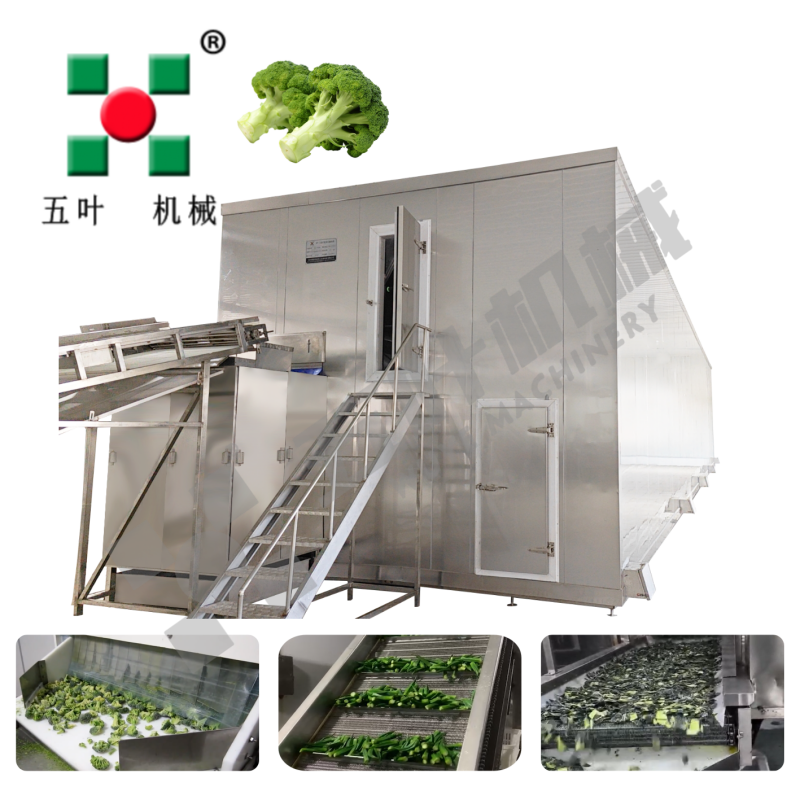
Tunnel freezers are linear systems where products travel on a continuous belt through a heavily insulated enclosure. Unlike fluidized beds that lift the product, standard tunnel freezers direct high-velocity cold air horizontally or vertically over the surface of the belt. Impingement tunnel freezers use specialized nozzles to blast high-pressure jets of cold air directly onto the top and bottom of the product. This strips away the thermal boundary layer for rapid heat transfer.
These systems are highly suitable for flat, heavy, or delicate products that cannot withstand the aggressive tumbling action of fluidization. Asparagus spears, large broccoli crowns, and leafy greens perform better in tunnel environments where they remain stationary on the belt.
Spiral freezers utilize a continuous conveyor belt that winds upward or downward in a helical pattern around a central rotating drum. The primary advantage of a spiral freezer is its vertical, space-saving design. It packs hundreds of meters of active belt length into a very small facility footprint using an overdrive system to manage belt tension.
While highly efficient for spatial constraints, spiral freezers are generally better suited for packaged frozen foods, meat patties, or larger bulk items. They are less optimal for raw, wet, loose vegetables. The extended dwell times and the mechanics of the spiral belt increase the risk of wet vegetables freezing directly to the stainless steel mesh. This requires aggressive scraping mechanisms that damage the product.
Processing facilities must choose between continuous inline systems and batch processing based on throughput requirements. High-throughput automated lines require continuous quick freezing equipment that integrates seamlessly with upstream vibratory shakers and downstream packaging machines. These systems run uninterrupted for days, handling thousands of kilograms per hour.
Batch-type instant freezers load products onto trays or racks placed inside a static blast cabinet. These are reserved for pilot plants, specialty garden harvests, or very low-volume seasonal runs where the capital investment of a continuous line cannot be justified.
Freezer Type | Airflow Dynamics | Best Suited For | Facility Footprint |
|---|---|---|---|
Fluidized IQF | High-velocity upward air, lifting product | Peas, corn, diced carrots, small loose items | Medium to Large (Linear) |
Tunnel / Impingement | Directed high-velocity jets (top/bottom) | Asparagus, delicate florets, flat products | Large (Linear) |
Spiral Freezer | Horizontal or vertical crossflow | Packaged goods, heavy bulk, large cuts | Small (Vertical) |
Broccoli and cauliflower present unique mechanical challenges. The florets are highly fragile and prone to shattering when frozen, generating unacceptable levels of broken pieces that lower the grade of the final product. The dense stalks freeze at a different rate than the delicate buds.
A specialized Broccoli IQF Freezing Machine requires gentle handling mechanisms. Belt transitions must be minimized and engineered with soft-drop chutes keeping drop heights under 100mm to prevent physical impact. The airflow must be carefully controlled. If the air velocity is too high, it tumbles and breaks the florets. Specialized belt mesh sizes support the irregular shape of the crowns, preventing them from rolling or wedging into the belt links during the freezing process.
Products like diced onions possess high moisture and high sugar content. High Brix levels lower their freezing point and make them incredibly sticky. If placed on a standard static belt, diced onions immediately fuse into a solid sheet of ice and vegetable matter.
Processing these items successfully requires a dedicated Diced Onion IQF Freezer equipped with a two-stage fluidization process. The first stage acts as a crust-freezing zone, utilizing mechanical agitation—such as pulsators or belt thumpers under the mesh—combined with high-pressure upward air. This violently shakes the sticky pieces apart while rapidly freezing their surfaces. Once the outer layer is frozen and the stickiness is neutralized, the product moves to the second stage for deep core freezing using standard fluidization.
Dense root vegetables, such as thick-cut carrots, potato wedges, or whole baby potatoes, carry significant weight and require extended dwell times to freeze completely to the core. Fluidizing these heavy items is often impossible or highly inefficient due to the massive air pressure required to achieve lift.
For these profiles, the evaluation shifts toward high belt load capacities. The equipment must feature robust, heavy-duty stainless steel belting capable of supporting dense product weights without stretching or derailing. The airflow is typically directed down through the product bed rather than upward, focusing on sustained thermal extraction over a longer linear footprint with bed depths reaching 100mm to 150mm.
The efficiency of thermal extraction relies entirely on airflow dynamics. Modern industrial freezers utilize Variable Speed Drives (VSD) on the evaporator fans. VSDs allow operators to precisely adjust the fan RPM and air velocity based on the specific weight and density of the product currently on the line.
Optimized aerodynamics play a critical role in yield retention. Poorly designed airflow strips excessive moisture from the vegetable surface before it freezes, leading to dehydration and weight loss. By maintaining a balanced, high-humidity, low-temperature air cycle, advanced fan technologies ensure the product retains its water weight, directly protecting the processor's yield.
The conveyor belt is the primary interface between the machine and the food. Processors generally choose between modular plastic belts and stainless steel wire mesh.
Modular Plastic Belts: Manufactured from Acetal or Polyethylene, these offer superior product release properties. Wet vegetables are far less likely to freeze and stick to plastic links compared to metal. They are lighter, reducing the mechanical strain on drive motors.
Stainless Steel Mesh: Metal belts provide unmatched durability and superior heat transfer. They are ideal for heavy loads and products that require aggressive cold penetration from the underside.
Regardless of the material, the belt hole sizing must be meticulously specified. The perforations must be large enough to allow optimal air penetration for fluidization or crossflow, yet small enough to prevent small vegetable pieces from falling through into the evaporator coils.
As wet vegetables enter a sub-zero environment, ambient moisture rapidly condenses and freezes onto the evaporator coils. Over time, this frost buildup chokes the airflow, drastically reducing the machine's freezing capacity and forcing a production shutdown for defrosting.
To maximize continuous uptime, advanced freezers employ Air Defrost (ADF) systems. ADF utilizes targeted blasts of compressed air at 6 to 8 bar to knock snow and frost off the coil fins while the machine is actively running. Sequential defrosting technologies allow specific sections of the evaporator to be isolated, warmed with hot gas, and cleared of ice while the rest of the freezer continues to operate. This extends continuous production runs from hours to several days.
Integrating a massive freezing enclosure requires precise spatial mapping. Linear tunnel and fluidized freezers demand significant floor space, not just for the equipment itself, but for maintenance access, belt washing stations, and safe clearance zones. Facility engineers must account for heavy floor loading requirements.
Integration risks extend to upstream and downstream equipment. The outfeed of the dicing machine must align perfectly with the infeed shaker of the freezer to ensure an even spread of product across the belt width. Downstream, automated packaging synergy is critical. High-speed multi-head weighers rely entirely on the freezer delivering perfectly separated IQF products. If the freezer discharges clumped vegetables, the weigh buckets jam, causing packaging line stoppages and inaccurate fill weights.
Food safety regulations mandate strict sanitation protocols for freezing equipment. The internal environment of a freezer, particularly during defrost cycles when temperatures rise and moisture pools, becomes a breeding ground for Listeria and other pathogens.
Processors must evaluate equipment for sanitary design. This includes fully welded 304 stainless steel enclosures that eliminate overlapping joints where bacteria harbor. Sloped floors with a minimum 1:100 pitch are necessary to ensure all washdown water drains rapidly into trench drains without pooling. Automated Clean-in-Place (CIP) systems are highly recommended. These systems utilize strategically placed spray nozzles to apply chlorinated alkaline foam and high-pressure rinses to belts, coils, and internal surfaces, ensuring repeatable sanitation with minimal manual labor.
Optimal selection requires aligning the equipment's thermodynamic and mechanical capabilities with the specific cellular structure, moisture content, and physical fragility of the target vegetables. Processors must move beyond basic specifications and evaluate how the machinery integrates with their exact product profiles and facility constraints.
Conduct physical product testing with original equipment manufacturers using your exact vegetable cuts to verify fluidization behavior and core freeze times.
Calculate the required central refrigeration capacity (considering systems running R507/R404A, ammonia, CO₂, etc.) based on peak harvest throughput, factoring in the latent heat of your specific product mix.
Audit your facility's floor space, heavy load bearing capacity, and trench drainage infrastructure to ensure seamless integration of the new enclosure.
Evaluate upstream cooling processes to guarantee vegetables enter the freezer at the lowest possible temperature, protecting your active freezing capacity.
Contact Shaoxing Jiesheng Food Machine Technology (Wuye Machinery) today to discuss how we can optimize your frozen vegetable production line with custom-engineered IQF solutions.
A: A blast freezer freezes large batches slowly, while an IQF freezer processes items continuously and rapidly. Slow blast freezing causes vegetables to clump together and form large, damaging ice crystals. An IQF freezer freezes individual pieces rapidly in minutes on a moving belt, preserving cellular texture and ensuring complete separation.
A: Quick freezing preserves the vegetable in a solid frozen state, whereas freeze-drying extracts all moisture. Quick freezing drops the temperature for standard cold chain distribution. Freeze-drying first freezes the product and then uses a deep vacuum to sublimate and extract moisture, resulting in a shelf-stable, completely dry product.
A: It uses high-velocity cold air forced upward to suspend and tumble individual vegetable pieces. This upward air pressure matches the weight of the product, creating a fluidized bed while rapidly freezing the pieces. This constant motion prevents clumping.
A: The best systems feature gentle handling mechanisms and soft-drop transitions under 100mm. They also utilize variable airflow controls to prevent fragile florets from shattering, and specialized belt meshes to prevent the crowns from rolling or wedging into the links.
A: Utilizing a dedicated freezer with a two-stage crust freezing zone is essential. This involves mechanical pulsators or belt thumpers combined with high-pressure upward air to violently separate the sticky, high-moisture onion pieces while instantly freezing their outer surfaces.
A: Pre-cooling significantly lowers the thermal load on the refrigeration coils. Chilling vegetables immediately after blanching removes residual heat, preventing excessive frost buildup and increasing the overall throughput capacity of the freezing line.
A: Automated packaging requires free-flowing, individually separated pieces. High-speed multi-head weighers calculate accurate bag weights based on separated pieces. If a freezer causes product clumping, the fused blocks will jam the packaging equipment, causing line stoppages and inaccurate fills.